Born into tradition, headed for innovation
Growing up in one of the oldest glassblowing families from the islands of Murano, Carlo Nason has always been surrounded by glass. What he was able to shape out of it, however, comes closer to art than craft.


He wanted to create something different, something unseen before.
Carlo Nason was born in Murano, Italy in 1935 into one of the glassblowing families on the islands. His father, Vincenzo Nason, was the head of the family company NasonMoretti and soon opened a second one named Vincenzo Nason & C. This is where Carlo Nason spent his youth and learned everything he needed to know to work along with the maestro’s. Nason himself reminisces about these days saying the vetreria felt like an extension of their family, not knowing where one ended and the other one started.
However, being inspired by pure, geometric shapes, Nason wasn’t interested in working for the traditional vetrerie. This is how his collaboration with Mazzega became reality. Providing him with the tools and granting him the freedom he needed, Nason started experimenting with hand-blown lamps. He wanted to create something different, something unseen before. In this first period of his design career with Mazzega, he was inspired by making lamps with several layers of glass, which certainly wasn’t easy, but worth it. One of these lamps is the LS-120 pendant lamp. Made of four layers of hand-blown glass, each piece was shaped individually. Nason achieved this through many trials and errors until the form turned out well, a luxury designers don’t have nowadays. We can clearly see the differences within the parts, indicated by a fluctuating thickness and changing bubble patterns. Therefore, the parts acquire a unique aspect, enhanced in the way that they can only fit in each other in one specific way. Through the juxtaposition of all the layers, a cascading shape comes to life, and with it a beautifully diffused light.

An artist's inspiration
His ideas sprung everywhere, from things he happened to observe to little accidents in the vetreria. Furthermore, he was inspired by nature and smooth, clear shapes, which he found in the Japanese culture. He has experimented with organic shapes, giving birth to creations such as his tulip lamp LS-185 and other opalescent table lamps.Carlo Nason was one of the first to experiment with industrial materials, such as metals, within the glass world. We can see this with his ‘I Numerati Soffiati’ floor lamp, where he combines mouth-blown glass pieces with steel parts. Furthermore, he impresses with his new approach where the base of the lamp can also be used as a light source. This is typical of Nason’s designs, always combining functionality with aesthetic pleasure. For him, light was as functional as sculptural.

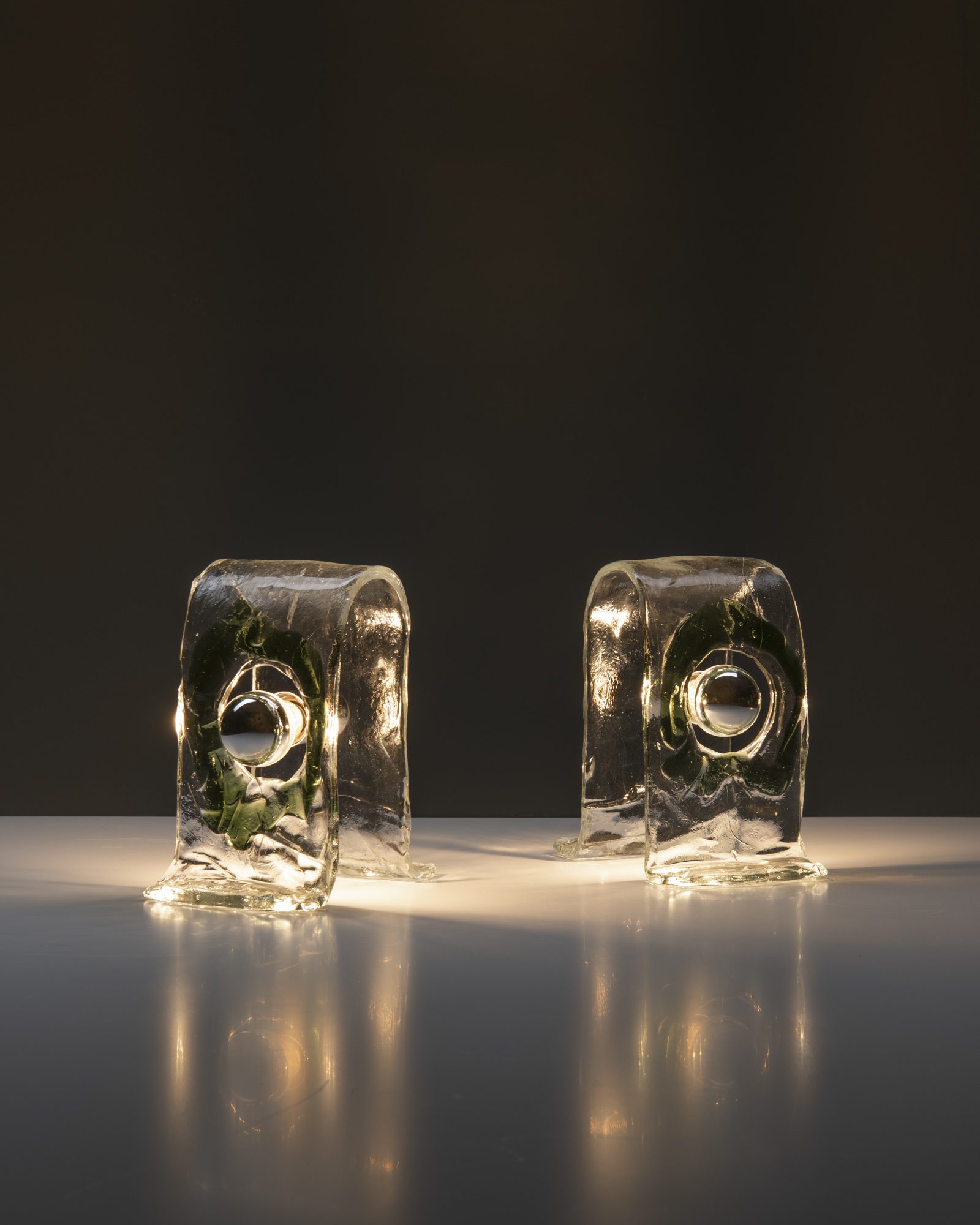
For him, light was as functional as sculptural.
In the 1980’s his collaboration with Mazzega came to an end. In the years that followed, Carlo Nason worked for other big glassblowing companies, such as I Tre, Murano Due and De Majo. Nason’s oeuvre continually pushes the boundaries set by traditional glassmaking techniques. He strived to revolutionize, incorporating new materials, colors and forms, shaping the way for modern Italian glass design. His works continue to fascinate up until today, being shown in some of the biggest museums and galleries in the world, from Milan and Paris to New York.